Numerology — Esoteric Numbers
Overview
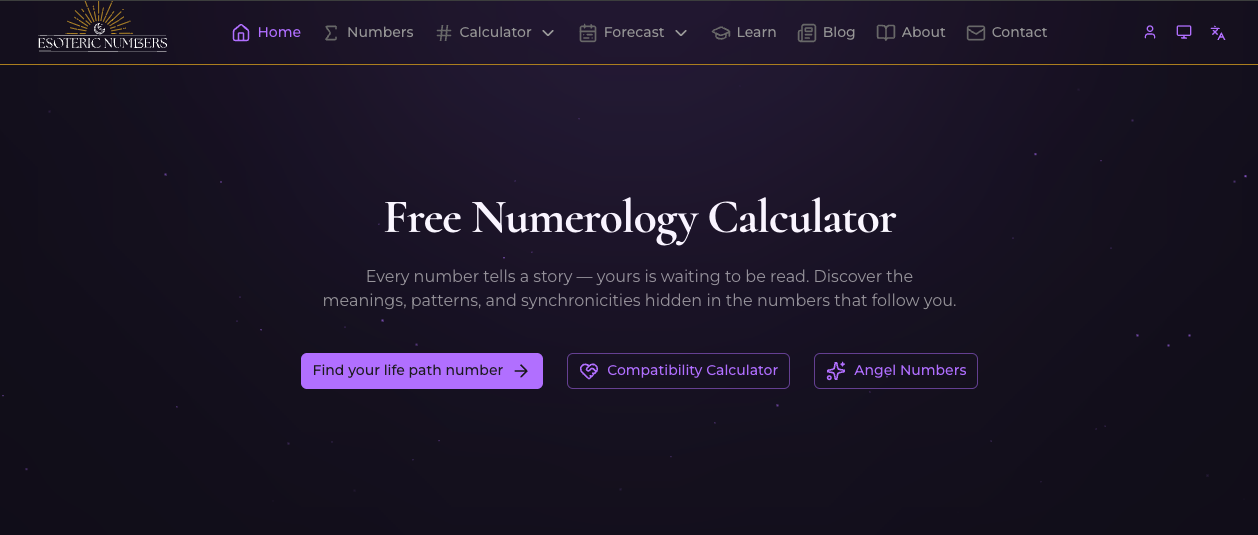
Esoteric Numbers is a comprehensive numerology platform where users can calculate over 25 distinct numerology metrics for free, purchase detailed PDF reports, explore compatibility charts, and read a multilingual blog. The entire calculation engine exists in two parallel implementations — a TypeScript library for instant client-side results and a Python mirror for server-side PDF generation.
Numerology Calculations
The platform supports 25+ calculation types across several categories. Name-based calculations include Expression, Motivation, Desires, Equilibrium, and Proper Name numbers using Pythagorean letter-to-number mapping. Birthday-based calculations cover Destiny (Life Path), Personality, Personal Year/Month/Day, and Universal Day numbers. Cycle-based analysis provides Life Periods with age boundaries, four Pinnacles with precise transition ages, and four Challenges. The Pythagorean Grid analysis generates a 3x3 Lo Shu Square revealing Karmic Lessons, Karmic Duties, Focus Numbers, and eight Arrows of Pythagoras (Determination, Spirituality, Intellect, Emotional Balance, Practicality, Planner, Will, Activity). Additional features include Letter Transits and Essence tracking, Palindrome Date finding, and specialty calculators for house numbers, baby names, wedding dates, and weekly forecasts.
Compatibility System
The compatibility module offers both basic and advanced analysis. Basic compatibility covers 66 unique pair combinations (numbers 1-9 plus master numbers 11 and 22) rated for intimate and business compatibility. Advanced compatibility uses a 0-100 scoring system based on five weighted factors: ruling harmony (25 points), plane harmony (20 points), arrow interaction (20 points), soul urge harmony (20 points), and outer expression harmony (15 points). Each of the 66 pairs has a dedicated SEO-optimised page.
Report Generation Pipeline
When a user purchases a report, a secure checkout session is created. Upon payment confirmation, a report is queued for generation. An asynchronous task runs all numerology calculations, renders a styled HTML template, and converts it to a professional PDF via a dedicated microservice. The finished report is stored securely and a download link is emailed to the user. Reports support template versioning and upgrade flows, with automated recovery for failed generations.
Internationalisation
The platform supports 65+ language and region variants across 68 locale files, including 8 English variants, 6 Spanish variants, CJK languages, Middle Eastern scripts, South Asian languages, and more. The English source file alone contains approximately 4,700 translation keys. Translations are managed through a custom Django i18n app that syncs source text to the database, translates via Ollama (a self-hosted LLM) with CJK-specific token limits and regional hints, and exports back to JSON. The frontend uses lazy loading for non-source locales.
Data Security
All personally identifiable information is encrypted at rest, including user names, birthdays, and email addresses. Hashed lookups are used for fields that need to be searchable without exposing the underlying data. The platform implements 2FA (TOTP) for user accounts and rate-limiting on sensitive endpoints.
Backend Architecture
The Django backend is organised into modular apps covering accounts and authentication, report generation, payment processing, a full blog CMS with rich-text editing and AI-powered content generation, a translation management system, activity audit logging, infrastructure monitoring, and a contact form. Each module is designed for separation of concerns and independent scalability.
Frontend
The Nuxt 3 frontend features 70+ pages, 63 Vue components, and 30 composables. Key areas include the free calculator with dedicated pages for each calculation type, number meaning pages, compatibility pair pages, a secure checkout flow, a user dashboard with saved profiles, a blog with rich-text editing, and a staff admin panel for content and translation management.
Infrastructure
Production runs via Docker Compose with multiple containerised services including a reverse proxy with TLS, the database with connection pooling, a cache layer, the application server, asynchronous task workers with a scheduler, a task monitoring dashboard, a PDF generation microservice, and a secure tunnel for public access. Monitoring includes error tracking, analytics, and a custom health-check system with uptime dashboards.